
This page has information on:
The first step to being able to spot any cancer symptoms is to know your body and what is normal for you.
You may or may not have been taught about the gynaecological organs (female reproductive system) at home or at school, but it is never too late to learn about your body and how you can look after your health.
The reproductive system
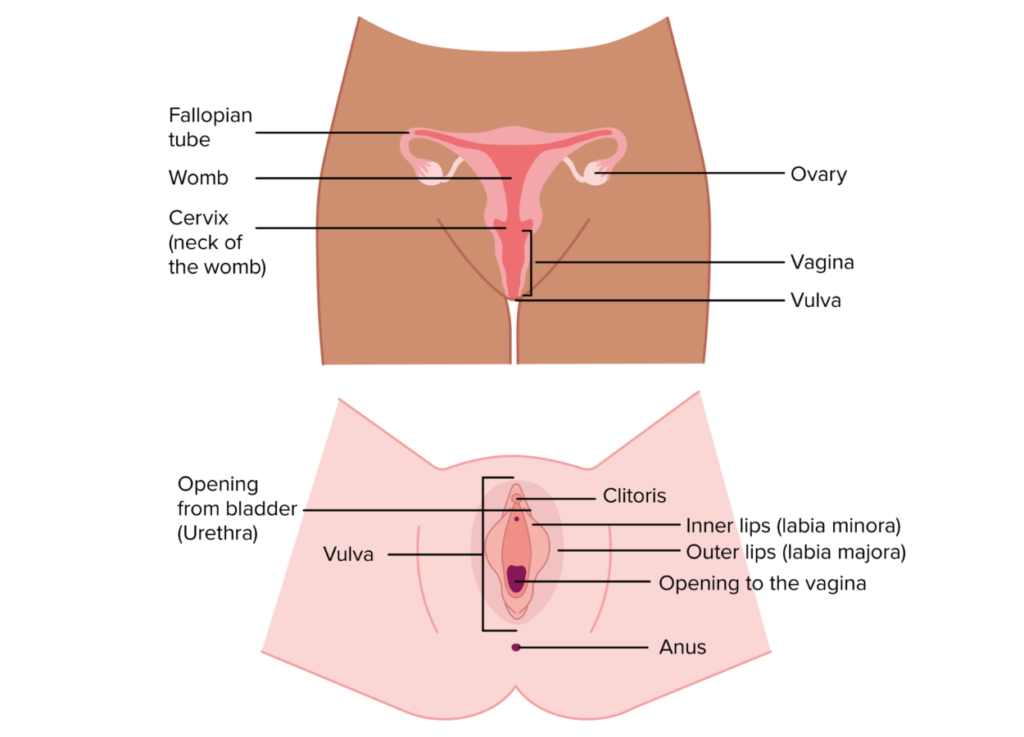
What are the ovaries?
The ovaries are two small organs about the size of grapes which are connected to the womb by the fallopian tubes. The ovaries are where eggs are stored. Each month (between puberty and menopause) one of these eggs is released into the fallopian tubes. The ovaries produce sex hormones, like oestrogen and progesterone, which control your menstrual cycle. After menopause, when your periods have stopped for 12 months or more, the ovaries stop releasing eggs and produce fewer hormones.
Key ovarian cancer statistics
7,500
people diagnosed each year in the UK
6th
most common cancer in women in the UK
What is ovarian cancer?
Cancer of the ovary is most common after menopause. But, it can affect anyone with ovaries at any age.
There are many types of ovarian cancer, epithelial ovarian cancer is the most common:
- Epithelial ovarian cancer – develops from cells on the surface of the ovary. It includes the sub-types:
- Endometrioid
- Clear cell
- Serous
- Mucinous
- Undifferentiated or unclassified
- Fallopian tube cancer – many ovarian cancers begin in the fallopian tubes. They are treated in the same way as ovarian cancer
- Primary peritoneal cancer is rare. It is similar to epithelial ovarian cancer. The peritoneum is a thin lining inside of the abdomen, covering the organs. The treatment is the same as ovarian cancer.
- Germ cell ovarian cancer – starts in the cells that create eggs in the ovary. This rare type of cancer most often affects teenagers. Some of these tumours are not cancerous (benign)
- Stromal ovarian cancer – (sex cord stromal tumours)– develops in the cells that hold the ovaries together. Granulosa cell tumours are the most common type. Some of these tumours are benign
- Small cell ovarian cancer – the least common type. It most often affects younger women and people with ovaries
- Cancer from other organs in the body can spread to the ovaries (metastatic cancer).
How does it develop?
Cells in the ovary start to change and grow abnormally. If the cancer isn’t found at an early stage, it can spread. This is usually to the abdomen and pelvis (peritoneal cavity).
What are the signs and symptoms of ovarian cancer?
The symptoms of ovarian cancer can be vague and similar to other conditions. It is often misdiagnosed as Irritable Bowel Syndrome (IBS). If you have any of the symptoms, speak to your GP as soon as possible.
The main symptoms of ovarian cancer are:
- Unexpected increased abdominal size and persistent bloating (not bloating that comes and goes)
- Feeling full quickly, loss of appetite or feeling sick
- Pelvic and/or abdominal pain
- Needing to wee (urinate) more often
- Changes in bowel habits.
Less common symptoms are: back pain, losing weight unexpectedly, feeling tired, and vaginal bleeding that is different or new.
If you have any of these symptoms, it is important you see your GP. It is more likely to be caused by something less serious than cancer, but it is always worth getting them checked. Just in case. The earlier ovarian cancer is caught, the more treatment options there are, and the best possible chance you have of successful treatment. Knowing what to look for and getting symptoms checked is really important.
Ovarian cancer is often misdiagnosed. If you’ve seen your GP about symptoms and they haven’t gone away, let your GP know.
What are the risk factors for ovarian cancer?
We don’t always know what causes ovarian cancer. But there are some factors that raise your risk:
- Age – Ovarian cancer can happen to anyone with ovaries at any age. But the risk does get higher the older you are. More than half of cases in the UK happen over 65.
- Family history – There are two inherited gene alterations (mutations) that are linked to a higher risk of developing ovarian cancer. These are BRCA gene alterations and Lynch Syndrome. If members of your family have one of these inherited risks, or you have a strong family history of breast, ovarian and prostate cancer or womb, bowel and ovarian cancer, ask your GP if you should be referred to a Clinical Geneticist. They will advise you on genetic testing. You can also get in touch with Ask Eve.
Inherited Risks
We have lots of information on inherited risks, BRCA gene alterations, lynch syndrome and genetic testing.
- Ovulation and fertility – Every time an egg is released, the surface of the ovary breaks to let it out. This damages the ovary, which needs to be repaired. Each time this happens, there’s a greater chance of abnormal cells growing. This may be why the contraceptive pill, multiple pregnancies and breastfeeding reduce your risk. This is because eggs aren’t released during this time.
- Endometriosis – This condition may raise your risk of a sub-type of peritoneal cancer (a rare form of ovarian cancer). In endometriosis, the cells that normally line the womb grow elsewhere in the body.
- Other Risk Factors – There are some other risk factors that may raise your risk of ovarian cancer: being overweight, smoking, exposure to asbestos, radiation exposure, diabetes and using hormone replacement therapy (HRT).
How is ovarian cancer diagnosed?
Your GP will gently feel your tummy (abdomen) and ask you about your symptoms. They will ask about your general health and your family history of breast and ovarian cancer.
Blood test (CA125) – You may have a blood test to look for a protein called CA125. A very high level of CA125 may show that you have ovarian cancer.
CA125 isn’t specific to ovarian cancer and it can be raised in other conditions, like endometriosis and pelvic inflammatory disease. A raised CA125 level doesn’t mean you definitely have cancer. Around 1 in 2 people with early stage ovarian cancer have a raised CA125. If your CA125 level is raised you will probably be referred for an ultrasound scan.
Ultrasound scan – You may be referred to your local hospital for an ultrasound scan. This uses high-frequency sound waves to create an image of your ovaries. You may have an ultrasound inside your body (called a transvaginal ultrasound). This is where an ultrasound probe is put into your vagina. You may also have a ultrasound outside of your body. This is where the probe is rolled over your tummy (abdomen).
The ultrasound will show the size and texture of your ovaries. It will also show any cysts or other issues.
Further tests – If you’ve been diagnosed with ovarian cancer, you will be referred to an oncologist and you will have further tests to see how large the cancer is and if it’s spread. This is called staging.
Other tests you may have could be:
- A CT scan – which will help your doctors choose the best treatment for you.
- A biopsy – a small tissue sample taken from the body. This may be done with either a CT or ultrasound scan to see your ovaries. This biopsy will be sent off for testing, and they may also look for alterations on the BRCA genes. We have a guide on genetic testing in ovarian cancer here.
Staging and grading ovarian cancer
These tests will enable your doctors to find out if you have ovarian cancer, which specific type of ovarian cancer you have, and its stage and grade. All of this information will help your doctors work out the best treatment options for you.
The staging of cancer looks at how big the cancer is and whether it has spread.
The grading of cancer looks at the type of cancer cells you have and how they act, and whether they multiply quickly or slowly.
Ovarian cancer stages:
- Stage 1 – early stage, the cancer is only in the ovary (ies) or fallopian tube (s)
- Stage 2 – the cancer has spread into the pelvis
- Stage 3 – the cancer has spread to the abdomen and lymph nodes
- Stage 4 – the cancer has spread to outside of the pelvis and abdomen to other areas of the body.
Ovarian cancer grades:
- Grade 1 – slow growing, the cells look quite similar to ‘normal’ cells . This may also be called low grade or well differentiated
- Grade 2 – cells grow faster than grade 1. This may be called moderate grade or moderately differentiated
- Grade 3 – cells grow faster and are more likely to spread. This may be called high grade or poorly differentiated.
What is the treatment for ovarian cancer?
Most women and people with ovarian cancer will be treated by a combination of chemotherapy and surgery.
Treatment plans are discussed at a multi-disciplinary team meeting, which will include gynaecologists, oncologists, radiologists, histopathologists and clinical nurse specialists. They will work out the best treatment option(s) for you based on where your cancer is and how advanced it is, your symptoms and well-being.
Sometimes, the cancer is treated with a type of surgery called primary debulking surgery either before or after some cycles of chemotherapy; this is known as interval debulking surgery.
Your surgeon will discuss what will happen during surgery. It will probably involve removing:
- both ovaries and the Fallopian Tubes (a bilateral salpingo-oophorectomy)
- the womb and cervix (a total hysterectomy)
- and part of the vagina (the vaginal cuff).
The surgeon may also remove the omentum (a fatty layer of tissue that covers the intestines and lower abdominal organs). In some cases, part of the bowel may need to be removed, and a reversable or permanent stoma might be needed (colostomy).
Chemotherapy is usually given either before surgery (called neo-adjuvant) or afterwards (adjuvant). If you do not have surgery, you will usually have more chemotherapy. Your oncologist will explain what to expect from your treatment plan and answer any of your questions.
Sometimes you may be offered a type of targeted therapy, to slow down or stop the growth of cancer cells. This will depend on the type and stage of cancer you have and how well your cancer has responded to chemotherapy.
Living with/beyond ovarian cancer
Living with and beyond ovarian cancer can affect many areas of your life. Everyone is different, some may have lots of different emotions. You may experience effects from your treatment months or even years later. Dealing with the loss of fertility and early menopause can be very difficult. It is important that you get the help, support and information you need. You can contact our Ask Eve nurses to chat about any worries or questions.
Find more information and advice
We have lots more information and tips on gynae cancers. You can also speak to our Ask Eve nurses for free to chat about any worries or questions.




Our health information meets PIF TICK quality mark.
The PIF TICK is a seal of approval from the Patient Information Forum. It helps you know if health information is trusted, evidence-based and accessible.
To be PIF TICK approved, health information creators must prove they meet 10 key criteria and undergo a robust, independent annual assessment.
Information updated: April 2026. Next review due: November 2027
Real stories

Sbba’s story
Sbba blogs about her ovarian cancer diagnosis, the importance of symptom awareness and her hopes for earlier detection.

Alison’s story
Alison shares her story of being diagnosed with breast then ovarian cancer and later finding out she had the BRCA gene alteration.

Shalisha’s story
Shalisha writes about her experience of ovarian cancer for Gynae Cancer Awareness Month.

Sophie’s story
Sophie shares her story of being diagnosed with ovarian cancer at 34. She believes we need to raise awareness so that both women and men know the symptoms of ovarian cancer.

Sunita’s story
Sunita was diagnosed with ovarian cancer at 33 after waking up one day extremely bloated. She shares her story to break down taboos around cancer and gynae health in the south Asian community.