
This page has information on:
The first step to being able to spot any cancer symptoms is to know your body and what is normal for you.
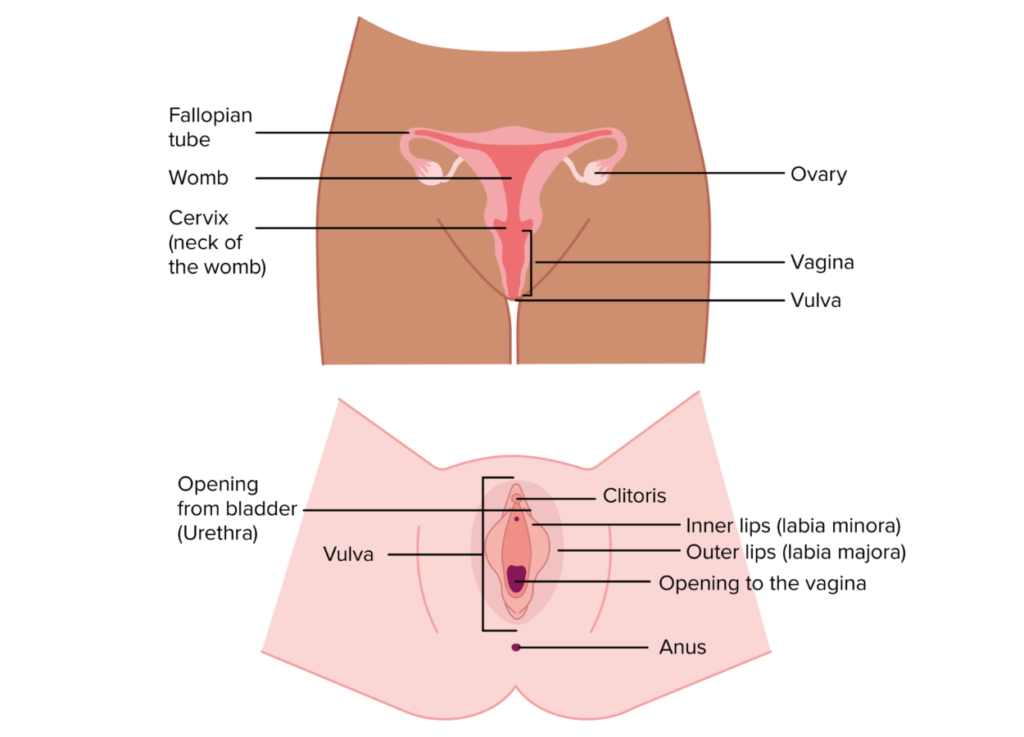
You may or may not have been taught about the gynaecological organs (female reproductive system) at home or at school, but it is never too late to learn about your body, and how you can look after your health.
The reproductive system
What is the vulva?
The vulva is the name for the external female genitals, that you can see between the legs. It includes the lips surrounding the vaginal opening (labia minora and labia majora), the vaginal opening, and urethral opening (where you wee from), the clitoris and the Bartholin’s glands (two glands either side of the vagina that release lubricating fluid).
Everyone’s vulva looks and feels different. So, it’s important to get to know what is normal for you. That way you can spot any changes and get them checked out. At least once a month, take out a mirror and look at your vulva.
What is vulval cancer?
Cancer of the vulva (also called vulvar cancer or vulval cancer) is one of the rarer cancers. Around 1,350 cases are diagnosed in the UK each year.
Around 80% of vulval cancers are diagnosed in women over 60, but anyone with a vulva can be diagnosed with vulval cancer at any age. We are seeing more women being diagnosed at younger ages.
Key vulval cancer statistics
1,350
cases of vulval cancer each year in the UK
8 in 10
cases happen in women over 60
How does vulval cancer develop?
There are a number of rare sub-types of vulval cancer, like mucosal melanoma. Different types of vulval cancer may behave in their own way. You may be cared for by gynaecologists and dermatologists (who specialise in melanoma) to give you the best all-round support.
Skin conditions that cause inflammation may develop into an early vulval cancer. The two most common being vulval intraepithelial neoplasia (VIN) and lichen sclerosus.
VIN does not mean you have cancer. It is the stage before a potential cancer may develop. Some of these cell changes will go away without the need for any treatment. But, finding these cell changes early could help to prevent vulval cancer.
What are the symptoms for vulval cancer?
The signs and symptoms of vulval cancer aren’t always obvious. The most common changes to look out for are:
- A lasting vulval itch
- Pain or soreness
- Thickened, raised, red, lighter or darker patches on the skin of the vulva
- An open sore or growth visible on the skin
- A mole on the vulva that changes shape or colour
- A lump or swelling on the vulva
- Bleeding or a blood stained discharge in between periods or after the menopause (when you haven’t had a period for 12 months or more).
If you have any of these symptoms, it is important you see your GP. It is more likely to be caused by something less serious than cancer. But, it is always worth getting them checked. Just in case. The earlier vulval cancer is caught, the more treatment options there are and the best possible chance someone will have of successful treatment. Knowing what to look for and getting symptoms checked as soon as possible is really important.
If your symptoms are being caused by something that isn’t cancer, getting them treated can help you feel comfortable again.
If your symptoms are persisting or getting worse, do go back to the GP. It can sometimes take a few visits to get the correct tests and diagnosis. Letting the doctor know you are okay with being examined or you would like a referral to a gynaecologist can help get you the correct tests sooner.
Cervical screening tests (sometimes called smear tests) help prevent cervical cancer. They don’t check for vulval cancer, or any other of the gynae cancers. So, it’s important to get any symptoms checked even if you have had a clear cervical screening test.
What are the risk factors for vulval cancer?
We can’t always tell what has caused vulval cancer. But, there are some factors known to raise the risk of it:
Vulval intraepithelial neoplasia (VIN)
VIN is a potentially pre-cancerous condition. This means there are changes to cells in the vulva that aren’t cancer. But could turn into cancer in the future if they don’t clear on their own or get treated. This is a gradual process that often takes well over 10 years.
Symptoms of vulva cancer are similar to those of VIN. They can include an itch in the vulva that doesn’t go away and raised patches of skin that are lighter, darker or redder than normal. If you have any of these symptoms, go and see your GP.
There are two types of VIN:
- Usual or undifferentiated VIN – this often affects women under 50 and is thought to be caused by HPV
- Differentiated VIN (dVIN) – this is a rarer type. It often affects women over 60. It is often linked to skin conditions on the vulva. This type is more likely to turn into a cancer.
Human papilloma virus (HPV)
HPV is a group of common viruses that are spread through skin-to-skin sexual contact. There are thought to be more than 200 types.
Most of us will come into contact with HPV during our lives. Our immune system often clears the virus on its own. It doesn’t usually cause any problems.
If HPV doesn’t clear and isn’t treated it can sometimes turn into cancer. Over 4 in 10 vulval cancers are linked to HPV.
Skin conditions
Some skin conditions can affect the vulva, like lichen sclerosus. In a small number of cases these are linked to a higher risk of vulval cancer.
Smoking
Smoking increases your risk of VIN and vulval cancer. This may be because smoking makes the immune system less effective, so it is less able to clear HPV.
How is vulval cancer diagnosed?
Your doctor will look at your vulva to check whether to refer you to a gynaecologist or a dermatologist.
Referral to a gynaecologist
The National Institute for Health and Care Excellence (NICE) recommends that GPs think about referring a woman who has an unexplained vulval lump or ulcer, or unexplained bleeding.
The gynaecologist will ask about your symptoms and look at your vulva again. They may recommend a test called a biopsy.
Biopsy
A biopsy is where a small sample of tissue is taken so it can be looked at under a microscope. This is to see what is causing your symptoms.
Your doctor will speak to you about your results around 7-10 days later.
Staging and grading vulval cancer
These tests will enable your doctors to find out if you have vulval cancer, which specific type of vulval cancer you have, and its stage and grade. All of this information will help your doctors work out the best treatment options for you.
The staging of cancer looks at how big the cancer is and whether it has spread.
The grading of cancer looks at the type of cancer cells you have and how they act, and whether they multiply quickly or slowly.
Vulval cancer stages:
- Stage 1 – early stage, the cancer is only in the vulva
- Stage 2 – the cancer has spread to the lower part of the vagina, urethra (where you wee from) or anus
- Stage 3 – the cancer has spread to surrounding tissues or lymph nodes
- Stage 4 – the cancer has spread to the pelvic bone or other organs in the body.
Vulval cancer grades:
- Grade 1 – slow growing, the cells look quite similar to ‘normal’ cells. This may also be called low grade or well differentiated
- Grade 2 – cells grow faster than grade 1. This may be called moderate grade or moderately differentiated
- Grade 3 – cells grow faster and are more likely to spread. This may be called high grade or poorly differentiated.
What are the treatments for vulval cancer?
Vulval cancer can be treated by surgery, radiotherapy and chemotherapy, or a combination of all three. Your treatment will depend on how far the cancer has spread and where it started.
Surgery
In most cases, treatment will involve surgery. The type of surgery will depend on the stage of the cancer. The surgery will try remove all of the cancer and a margin of healthy skin. The skin removed during surgery will be checked for potential spread.
Your clinical team will talk you through your treatment options. This will depend on your exact cancer type, its grade and stage.
There are three surgical options to treat cancer of the vulva:
- Radical wide local excision – the cancerous tissue from the vulva is removed, as a well as a margin of healthy tissue, at least 1cm wide, to try stop the cancer spreading
- Radical partial vulvectomy – a larger section of the vulva is removed, this may include the labia and the clitoris
- Radical vulvectomy – the whole vulva is removed- the inner and outer labia, and possibly the clitoris and removal of some lymph nodes
- In some centres they will use sentinel node surgery, where a safe radioactive dye is injected into the first few lymph nodes a tumour drains into. This dye will highlight any potential spread into other lymph nodes. It will give the surgeon a guide of what lymph nodes to remove. These will be sent off for testing. Removing fewer lymph nodes will help reduce the long-term side effect of lymphoedema.
- If the skin cannot be stitched back together after a radical vulvectomy, your surgeon may offer reconstructive surgery at the same time as your surgery. A flap of skin is taken, usually from either your thighs or buttocks, to rebuild the area and cover your wound.
Chemotherapy
Sometimes chemotherapy may be offered before surgery to shrink the cancer and make surgery more effective or if you are too unwell to have a big operation.
Chemotherapy may be offered with radiotherapy (chemoradiation) after surgery to kill any left over cancer cells to reduce the risk of the cancer recurring.
Radiotherapy
This may be offered before, after or instead of surgery and you may have it with or without chemotherapy, depending on the stage and type of your cancer.
Life with/after vulval cancer
Living with and beyond vulval cancer can affect many areas of your life. Everyone is different, some may have lots of different emotions. Others have effects from treatment months or even years after it has finished. Some people have trouble with their sex life. It is important that you get the help, support and information you need. You can contact our Ask Eve nurses to chat about any worries or questions.
More information
We have lots more information and tips on gynae cancers. You can also speak to our Ask Eve nurses for free to chat about any worries or questions.





Our health information meets PIF TICK quality mark.
The PIF TICK is a seal of approval from the Patient Information Forum. It helps you know if health information is trusted, evidence-based and accessible.
To be PIF TICK approved, health information creators must prove they meet 10 key criteria and undergo a robust, independent annual assessment.
Information updated: April 2026. Next review due: November 2027
Real stories

Mandy’s story
Mandy was diagnosed with vulval cancer in 2012, and has had 7 surgeries since. She tells us about how her cancer has affected her whole family.
Matthew and Clare’s Story
Matthew speaks openly and honestly about his wife, Clare’s, diagnosis of vulval cancer, and how the ordeal has affected them both.

Helen’s story
Helen shares her story of vulval cancer to raise awareness of the importance of knowing your normal.