
This page has information on:
Colposcopy helps your nurse or doctor look closely at your cervix. It checks to see if there are changes to your cells. This is done by a specially trained nurse or doctor called a ‘colposcopist’.
Colposcopy normally happens in a hospital or local clinic. It takes around 10–20 minutes. But it might be longer, depending on what happens during your appointment.
Before your colposcopy
Why have I been invited to colposcopy?
You’re usually invited for colposcopy after cervical screening if:
- Your cervical screening result shows both high-risk HPV and cell changes
- You don’t have cell changes, but you’ve had three cervical screening results in a row with high-risk HPV
- You’ve had a few cervical screening tests with an unclear result
- The nurse or doctor who did your cervical screening wanted a colposcopist to have a look at your cervix for a second opinion.
You may also be referred for colposcopy because:
- You’ve had unusual bleeding from your vagina that isn’t your period (like bleeding after sex, between your periods or after menopause)
- Your periods have been heavier than normal
- You have a cervical ectropion. This is a harmless condition where cells from the inside of the cervix grow on the outside of the cervix. It can cause heavy vaginal bleeding and bleeding during or after sex.
If this is your second or follow-up colposcopy appointment
You could be going to a second or follow-up colposcopy appointment if:
- A biopsy was taken from your cervix at your first colposcopy appointment, and it found that you need treatment
- You’ve been invited for another check-up after your first colposcopy
- You have CIN2 cell changes and these are being checked.
Your frequently asked questions
We have answered some of your most common questions about colposcopy.
Do I have to go to colposcopy?
It’s your choice whether you go to your appointment, just like cervical screening. But you are only invited to colposcopy if healthcare professionals think you need it.
We understand that you might be worried. It may be helpful to remember that you’re in control in your appointment. We have some tips to make cervical screening easier which can also help with colposcopy appointments.
If you have any questions, you can speak to your GP or the hospital or clinic you’ve been referred to. You can also speak to our Ask Eve Nurses for free and confidential advice and information.
What should I do if I’ll be on my period for my appointment?
If you think you will be on your period for your appointment, get in touch with your hospital or clinic. You may still be able to have the colposcopy, but it may need to be rearranged.
Should I go to colposcopy if I’m pregnant?
It’s advised that you still go to your colposcopy appointment if you’re pregnant. A colposcopy will not harm your baby, and will help decide what happens next.
If you have cervical cell changes and get pregnant while you are waiting for your colposcopy appointment, tell your hospital. They will advise you what to do next. If you are seen early in your pregnancy, you may need another check later on in your pregnancy.
Most women and people who are pregnant can have a colposcopy in the late first or second trimester of their pregnancy, unless there is a clinical reason why they can’t. Your colposcopist will be able to tell you more about this. If you have low grade cell changes, your colposcopy may be postponed until after you have given birth.
If your colposcopist thinks it is needed, they may want to take a biopsy (a sample from your cervical cells). They will talk to you about this first and you will be able to ask any questions.
Can I bring someone with me for support?
You may want to bring a friend, family member, partner, or carer to help you feel more comfortable. Get in touch with your hospital or clinic and they will let you know if you can bring someone.
Can I request a colposcopist of a certain gender?
If you would like a doctor or nurse of a certain gender, you can contact your hospital or clinic. They will let you know if this is possible.
What can and can’t I do before my colposcopy appointment?
To make it easier to look at your cervix at your colposcopy, it is advised not to use vaginal medications, lubricants, or creams for at least 24 hours beforehand. If you aren’t sure about what you can or can’t do before colposcopy, you can speak to your hospital or clinic.
Do I need to bring anything with me?
You may want to bring a period pad or pantyliner with you. It’s common to have some discharge or light bleeding (spotting) from your vagina after a colposcopy.
What happens at a colposcopy appointment?
Your colposcopist will explain why you’ve been invited and what will happen. They may ask you some questions about your medical history. This is to help with the examination. You can ask them any questions to help you feel more comfortable.
There will be a private space for you to undress from the waist down. You will be given a paper sheet or towel to cover yourself. Your colposcopist will ask you to lie on the examination bed. It will have some padded supports to put your legs or feet on.
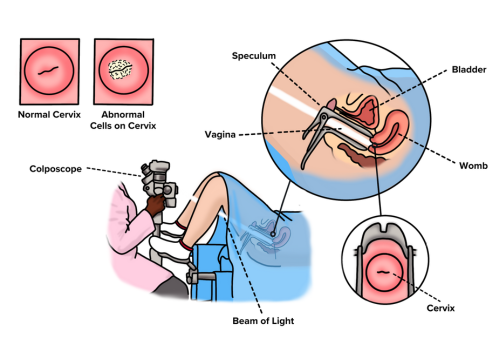
When you’re ready, your colposcopist will put a new, clean sterile speculum into your vagina. A speculum is a plastic or metal tube which gently opens the vagina. It will give your colposcopist a clear view of your cervix. They will then use a microscope with a light to have a look at your cervix. This is called a ‘colposcope’. It stays outside your body.
Liquid tests
The colposcopist will usually put some liquid on your cervix. This helps any changes in the cells to show up.
They may use:
- Acetic acid (a dilute vinegar) — your colposcopist will put a small amount on your cervix with a cotton wool ball or a spray. It turns cell changes white, so they are easy to see. You may feel some stinging.
- Iodine — your colposcopist might put a liquid called iodine solution on your cervix. It stains ‘normal’ cervical cells dark brown. Cell changes don’t usually stain, so the colposcopist will be able to see them. This is sometimes called ‘Schiller’s iodine test’.
Taking a biopsy
Your colposcopist may take a sample of cells from your cervix. This sample is smaller than a grain of rice and is called a ‘punch biopsy’. Sometimes it’s just called a ‘biopsy’.
Your colposcopist will let you know if you need one before it happens. Some people find it uncomfortable, but it shouldn’t be painful. Remember, you’re in control. You can ask your colposcopist to stop at any time.
If you’re nervous, it’s sometimes possible to have the area numbed (local anaesthetic). If you find it very uncomfortable, you may need to come back. This is so you can have it done under general anaesthetic (where you’re put to sleep). You can also be sedated (where you have an injection to help you relax and reduce pain). Your colposcopist will talk you through your options.
Your colposcopist might take more than one biopsy. This is to make sure they have enough tissue from different areas of your cervix. They then send the tissue to a laboratory for testing. They will look to see if:
- You have any cell changes
- What type of cell changes you have.
Your frequently asked questions
We have answered some of your most common questions about what to expect in your colposcopy appointment.
Who will do my colposcopy?
Your colposcopy and any treatment you have in your appointment is done by a ‘colposcopist’. They sometimes have different job titles, but they have all done the same colposcopy training. They may be called:
-A colposcopist — these are medical doctors who have done specialist colposcopy training
-A nurse colposcopist or colposcopy nurse specialist — these are registered nurses who have done specialist colposcopy training
There may also be an assisting nurse with you. They will be there to support you during your colposcopy appointment.
Will the colposcopist tell me if I have cervical cancer?
Your colposcopist will try to give you as much information as they can. But the results of a biopsy are usually needed.
Most people who go to colposcopy don’t have cervical cancer. If you have any questions or worries, there is time before and after your examination to talk these through with your colposcopist.
Will I have treatment at colposcopy?
Not everyone invited to colposcopy will need treatment.
Sometimes, your colposcopist can see that cell changes need treatment during your first colposcopy appointment. They can then treat you then and there. This is called ‘see and treat’.
If you are not treated then, you may be given another appointment for a different day.
This choice will be made by you and your colposcopist. Any treatment will be explained to you before it happens. Treatment is only given if you agree. It’s okay to ask as many questions as you need to before agreeing. It’s also okay to ask for time to think about it. Or you can ask to have your treatment later at another appointment.
The most common treatment is called large loop excision of the transformation zone (LLETZ). This removes a small area of the cervix where the cell changes are. It’s usually done with a local anaesthetic, which numbs the area being treated. You may also have a sticky pad put on your leg. This is for your safety as electricity is used in LLETZ. Sometimes you may need to be asleep with general anaesthetic during LLETZ. Your colposcopist will be able to talk to you more about this.
At the end of your colposcopy appointment
After the examination, your colposcopist will check you feel okay. They will give you information about what to expect after your appointment and ask if you have any questions. They will give you contact numbers for the hospital or clinic, in case you have any questions afterwards.
Sometimes, your colposcopist can tell you if they found anything straight away. But the results of your biopsy are needed to give you your full results. They will let you know when you might get your results.
After your colposcopy appointment
You can leave the hospital or clinic as soon as you feel ready. After colposcopy, you can go to work or do any other activities as usual. But you may prefer to rest, particularly if you had treatment during your appointment. It’s important you follow the advice given to you by your colposcopist.
Your frequently asked questions
We have answered some of your most common questions about what to expect after your colposcopy appointment.
Will I have side effects after my colposcopy examination or biopsy?
After your colposcopy, you might have:
-Light bleeding (spotting)
-Discharge from your vagina that is brown or has blood in it
-Cramps, like period pains.
We understand this might be worrying. It is common to have some or all of these effects after a colposcopy, even if you didn’t have a biopsy. They normally stop after a few days. If you bleed for more than a week, or if it gets heavier, then contact your GP, hospital or clinic where you had the appointment. You may also have side effects after treatment to remove cell changes.
Can I exercise after colposcopy?
After your colposcopy, you should stick to light exercise like walking and your usual daily activities for 24 hours.
If you’ve had a biopsy, you should avoid heavy lifting for 24-48 hours, and keep to light exercise for the first 24 hours. Avoid swimming until your spotting or discharge stops.
If you’ve had treatment, you may take a little longer to heal. Side effects of some treatments can last about 4–6 weeks. Avoid strenuous exercise for two weeks, like running, swimming, and playing sports. Your colposcopist can talk to you about this.
It’s important to listen to your body and take the time you need to rest. What feels right for someone else may not be right for you.
Can I have sex or masturbate after colposcopy?
Sometimes, a biopsy or treatment at colposcopy can cause bleeding or changes to your vaginal discharge. It’s best to wait until this stops before putting anything in your vagina. This includes:
-Penetrative vaginal sex — having a penis or sex toys inside your vagina
-Fingering (having fingers inside your vagina)
-Oral sex (having a tongue inside your vagina).
It’s okay to have anal sex or clitoral stimulation as you aren’t putting anything in your vagina.
Can I use tampons or menstrual cups after colposcopy?
If you have spotting or discharge, it’s best to wait until it stops before using tampons or menstrual cups. You should also avoid using vaginal medications, lubricants or creams.
Should I have a follow-up appointment after colposcopy?
Not everyone who goes for a colposcopy will have more than one appointment. You may be invited to a second or follow-up appointment if:
-Your biopsy result shows you need treatment.
-You have CIN2 cell changes and these are being monitored.
-Your colposcopist decides you need a follow up.
Colposcopy results
Your results will tell you what the colposcopist saw during your appointment. They will also tell you the results of your biopsy if you had one.
What do my colposcopy results mean?
Your colposcopy results are different to the ones you got for cervical screening. If you have any questions, your colposcopist or GP will be able to explain what your results mean. You can also speak to our Ask Eve Nurses for free and confidential information and advice.
Normal result
About 4 in 10 colposcopy results are normal. This means no cell changes were found in your cervix. You can have a normal colposcopy result even if you had an abnormal cervical screening result.
If you have a normal result, you don’t need treatment and are at low risk of developing cervical cancer. You’ll be advised to keep going for cervical screening when invited. This is in case cell changes appear in the future. You’ll be invited every 3-5 years depending on how old you are and where you live in the UK.
Abnormal result
About 6 in 10 colposcopy results are ‘abnormal’. This means the colposcopy or biopsy found cell changes in your cervix. Your results may tell you that you have either:
- Cervical intraepithelial neoplasia (CIN)
- Cervical glandular intraepithelial neoplasia (CGIN)
- Stratified mucin producing intraepithelial lesion of the cervix (SMILE).
Rarely, a colposcopy result will show cervical cancer. If this happens, you’ll be referred to a team of specialists to discuss your treatment.
Getting an abnormal result can be worrying. If you have any questions or worries, you can speak to our Ask Eve Nurses for free information and advice on nurse@eveappeal.org.uk or by calling 0808 802 0019.
Other words you might see in your results
- ‘Dyskaryosis’ — this name is given to small changes that can be seen in cells.
Your frequently asked questions
We have answered some of your most common questions about your colposcopy results.
When will I get my colposcopy results?
Sometimes, your colposcopist will tell you what they found in your appointment. You may also have a biopsy, which is looked at in a laboratory. This means it may take around 4–8 weeks to get your results. You’ll get them in the post. If you don’t get your results within this time, you can call the hospital or clinic where you had your colposcopy appointment.
Rarely, colposcopy results may show cervical cancer. If this happens, you should be referred to a team of specialists within two weeks.
Why is my colposcopy result different to my cervical screening result?
Cervical screening tests for HPV, and if it is present, if there are cell changes. But it doesn’t tell us everything about those cells. Colposcopy gives a closer look at your cervix and if any changed cells need to be monitored or treated. This means your colposcopy result may be different to your cervical screening result.
Not everyone who goes to colposcopy after cervical screening has:
-Cell changes
-The type or grade of cell changes their cervical screening result suggested.
If my colposcopy results show that I have CIN or CGIN, does it mean I have cervical cancer?
No, cervical intraepithelial neoplasia (CIN) or cervical glandular intraepithelial neoplasia (CGIN) means you have changes to the cells in your cervix (which can also be called abnormal cells or dyskaryosis). These changes are not cancer. If these cell changes aren’t monitored or treated, they can turn into cancer over time.
More information and advice
We have lots more information HPV, cervical screening and what happens if you have a HPV positive result. You can also speak to our Ask Eve nurses for free to chat about any worries or questions.





Our health information meets PIF TICK quality mark.
The PIF TICK is a seal of approval from the Patient Information Forum. It helps you know if health information is trusted, evidence-based and accessible.
To be PIF TICK approved, health information creators must prove they meet 10 key criteria and undergo a robust, independent annual assessment.
Information launched: April 2025. Next review due: April 2028.