
This page has information on:
The first step to being able to spot any cancer symptoms is to know your body and what is normal for you.
You may or may not have been taught about the gynaecological organs (female reproductive system) at home or at school, but it is never too late to learn about your bodies, and how you can look after your health.
The reproductive system
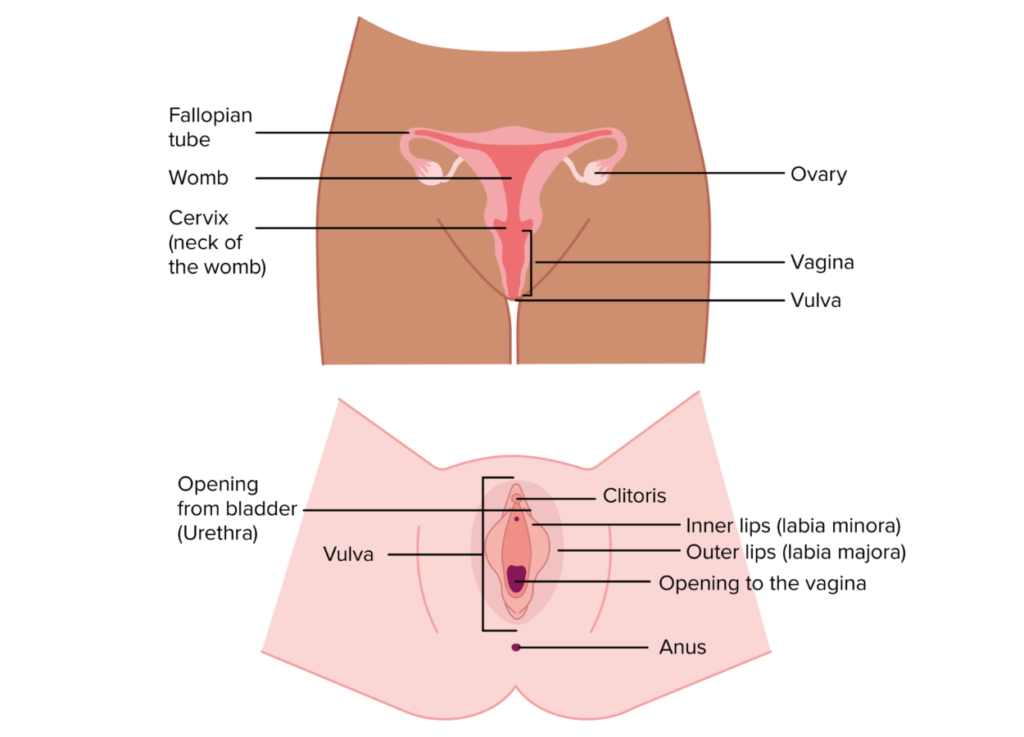
What is the vagina?
The vagina is an internal muscular canal which connects the outside of the body, where the vulva is, to the cervix. The vagina is where the lining of the womb is shed during a menstrual period and where a baby comes out during childbirth.
What is vaginal cancer?
Vaginal cancer is the least common gynae cancer. It is most common over the age of 75 (40%) but anyone with a vagina can be diagnosed with it at any age, so if you notice any changes to your vagina, it’s important to go and get checked.
250
women and people with gynae organs are diagnosed with it each year in the UK
1-2%
of all gynae cancers diagnosed are vaginal cancer
How does it develop?
Vaginal cancer, like cervical cancer, is strongly linked with human papilloma virus (HPV), 3 out of 4 vaginal cancers are linked to HPV.
The most common type of vaginal cancer is squamous cell carcinoma. 9 out of 10 cases of vaginal cancer are this type. This cancer may look like small ulcers or lumps close to the cervix. 1 in 10 vaginal cancers is caused by an adenocarcinoma. These are often inside the vaginal canal. Other types of vaginal cancer are melanoma, lymphoma and sarcoma. These are much less common.
What are the symptoms?
The signs and symptoms of vaginal cancer aren’t always obvious. Up to 1 in 5 patients don’t have any symptoms at all. The most common changes to look for are:
- Unexpected vaginal bleeding
- Vaginal discharge that smells or may be blood stained
- Vaginal pain during sexual intercourse
- A vaginal lump or growth that you or your doctor can feel
- A vaginal itch that won’t go away
- Pain when urinating (peeing)
- Persistent pelvic and vaginal pain.
If you have any of these symptoms, it is important that you see your GP. It is more likely to be caused by something less serious than cancer, but it is always worth getting them checked. Just in case. The earlier vaginal cancer is caught, the more treatment options there are and the best possible chance someone will have of successful treatment. Knowing what to look for and getting any symptoms checked is really important.
What are the risk factors?
We don’t often know exactly what causes a vaginal cancer. But, there are some factors that raise your risk:
Age
40% of cases are in people over the age of 75.
Human papilloma virus (HPV)
HPV is a group of common viruses that are spread through skin-to-skin sexual contact. There are thought to be more than 200 different types.
Most of us will come into contact with HPV during our lives. Our immune system often clears the virus on its own. HPV doesn’t usually cause any problems. HPV does not cause any symptoms. It can lay dormant in the body for years. It’s not possible to tell when or where you got HPV.
HPV causes cell changes, which can sometimes turn into cancer. These cell changes can be treated or monitored to stop them turning into cancer. Over 3 in 4 cases of vaginal cancer are linked to HPV.
Getting the HPV vaccine (if you are eligible) and using condoms may help to reduce your risk.
Abnormal cells in the cervix or vagina
You’re more likely to get vaginal cancer if you’ve had abnormal cells in your:
- Cervix – known as cervical intraepithelial neoplasia (CIN)
- Vagina – known as vaginal intraepithelial neoplasia (VAIN)
CIN and VAIN are terms used to describe cells that have changes. These changes are not cancer. CIN and VAIN are closely linked to a lasting HPV infection.
Other risk factors are: having cervical cancer, having womb cancer treated with radiotherapy, smoking and having a weakened immune system (including lupus, and HIV/AIDS).
How is it diagnosed?
If you go to the doctor because of vaginal bleeding, pain, discharge or other symptoms, your GP will ask you about them. They may also look at your vulva (the external genitalia). Then they may take a look inside your vagina. They will put on a pair of gloves and gently put 1 or 2 fingers in your vagina. This is to check and see if they can feel anything unusual. A lubricating gel will be used to make this more comfortable for you. A speculum will also be used so your doctor can see the cervix at the top of the vagina. They may also take a vaginal swab to check for any signs of infection.
If your GP cannot find a cause for your symptoms they will most likely refer you for more tests.
If you are referred to a gynaecologist, you may have:
- An examination – An external and internal examination to look for any unusual vaginal lumps or swellings
- A colposcopy – this is where a speculum is placed into your vagina so that it can be opened gently. A tool called a colposcope, which is like a small magnifying glass with a light, will be used to look at your vagina and cervix. The colposcope does not go inside you. It can show up anything that looks abnormal
- A biopsy – If your gynaecologist thinks there may be something inside your vagina, a small sample of the tissue will be removed (a biopsy) and checked under a microscope.
A colposcopy
These examinations can be uncomfortable for some people. The doctor will try and make sure you are as comfortable as possible. If the results show you have cancer, you will be sent for more tests to see if it has spread. These tests may include another internal vaginal examination under general anaesthetic, an MRI scan, a CT scan (often of your chest, abdomen and pelvis) and possibly a PET scan (shows 3D images of the inside of your body and highlights any abnormal areas). The doctors will talk to you about the type of scans you need.
Staging and grading vaginal cancer
These tests will enable your doctors to find out if you have vaginal cancer, which specific type of vaginal cancer you have, and its stage and grade. All of this information will help your doctors work out the best treatment options for you.
The staging of cancer looks at how big the cancer is and whether it has spread.
The grading of cancer looks at the type of cancer cells you have and how they act, and whether they multiply quickly or slowly.
Vaginal cancer stages:
- Stage 1 – early stage, the cancer is only in the vagina
- Stage 2 – the cancer has spread outside of the vagina into surrounding tissues
- Stage 3 – the cancer has spread to the wall of the pelvis and/or lymph nodes
- Stage 4 – the cancer has spread to other organs in the body.
Vaginal cancer grades:
- Grade 1 – slow growing, the cells look quite similar to ‘normal’ cells. This may also be called low grade or well differentiated
- Grade 2 – cells grow faster than grade 1. This may be called moderate grade or moderately differentiated
- Grade 3 – cells grow faster and are more likely to spread. This may be called high grade or poorly differentiated.
What are the treatments?
The treatment for vaginal cancer will depend on where the cancer is in your vagina and how far it has spread. Your doctors will talk to you about the best treatment for you.
Radiotherapy
Radiotherapy is the main treatment for vaginal cancer. It can be done in a few ways:
- External beam radiotherapy – this comes from a machine which beams high-energy rays at your vagina and pelvis from outside your body
- Internal radiotherapy (brachytherapy) – a small radioactive device is put into your vagina for a short period of time. Normally just a few hours. This treatment is often paired with something else
Surgery
Your doctor may suggest an operation, depending on where your cancer is and how far it has spread. The four main types of surgery to treat vaginal cancer are:
- Partial vaginectomy – removing the upper part of your vagina
- Radical vaginectomy – removing all of your vagina and pelvic lymph nodes
- Radical vaginectomy and radical hysterectomy – removing all of your vagina, womb, ovaries, fallopian tubes and pelvic lymph nodes
- Pelvic exenteration – removing all of your vagina, cervix, womb, ovaries, fallopian tubes and surrounding tissue, including lymph nodes, bladder, urethra, rectum and anus
- Vaginal reconstruction – If you have part or all of your vagina removed, you may be able to have a vaginal reconstruction. This is when skin, fat and muscle, are taken from other parts of your body, to recreate part or all your vagina. This means you may be able to have vaginal sex again. Vaginal reconstruction is not suitable for everyone. It is helpful to chat to your doctors about whether this is an option for you.
A very small number people with stage 1-2 vaginal cancer will have radiotherapy after their surgery.
Chemotherapy
Chemotherapy can be used to treat vaginal cancer. Sometimes it is paired with radiotherapy. This is called concurrent chemo-radiation.
The future of vaginal cancer treatment
Whilst there have been advances in radiation therapy, more research is needed to improve the treatments for vaginal cancer. This may include immunotherapy, which uses the immune system to kill the cancer cells, or other targeted treatments (drugs which target specific proteins and genes which help cancer cells survive and grow).
Life with/after vaginal cancer
Living with and beyond vaginal cancer can affect many areas of your life. Every woman is different, some may have lots of different emotions. Others experience effects from treatment months or even years afterwards. Some have troubles with their sex life. It is important that you get the help, support and information you need. You can contact our Ask Eve nurses to chat about any worries or questions.
More information
We have lots more information and tips on gynae cancers. You can also speak to our Ask Eve nurses for free to chat about any worries or questions.





Our health information meets PIF TICK quality mark.
The PIF TICK is a seal of approval from the Patient Information Forum. It helps you know if health information is trusted, evidence-based and accessible.
To be PIF TICK approved, health information creators must prove they meet 10 key criteria and undergo a robust, independent annual assessment.
Information updated: April 2026. Next review due: November 2027
Real stories

Kathy’s story
Kathy shares her story of her vaginal cancer diagnosis, her treatment and the cancer advocacy work she does as part of her recovery.

Helen’s story
Helen talks though her vaginal cancer diagnosis this year, her treatment and her recovery.

Laura’s story
Laura talks about her experience after she was diagnosed with vaginal cancer just as the pandemic hit in 2020, and urges everyone to get any worrying symptoms checked.