There are some risk factors that you can change to reduce your risk. These will not prevent you from getting cancer, but they will help to make it less likely. There are also some factors that you can’t change or may not want to change.
Having any of these risk factors does not mean you will get cancer, but they increase your risk of developing cancer during your lifetime compared to someone without the risk factor. Knowing about your risk factors can help you be aware of your risk.
This page has information on:
Lifestyle
Healthy eating and physical activity
Being overweight increases the risk of you developing some cancers, particularly womb, ovarian and other types of cancers. You can reduce your risk by maintaining a healthy weight, eating a balanced diet, reducing your alcohol intake and being physically active. Adults should try and exercise every day, aiming for 30 minutes of physical activity five times a week. You can find some general healthy eating and fitness ideas here:
If you have not exercised for a while or are not sure if it is safe, always speak to your GP or clinical team.
Smoking
Smoking is the largest cause of cancer in the UK. It increases the risk of developing cervical, vaginal, vulval and other types of cancers by weakening your immune system and damaging cells. This makes it harder for your immune system to clear high-risk human papillomavirus (HPV). HPV is a common virus, which 8 in 10 of us will get at some point during our lives. Our immune systems usually clear HPV within two years without causing any problems. If HPV isn’t cleared and ‘persists’ it can sometimes lead to the development of certain cancers.
Smoking is also associated with a slightly increased risk of mucinous ovarian cancer which is rare.
Stopping smoking can reduce your risk of cancer and improve your overall health. If you’d like to quit smoking, the NHS has support to help:
Symptoms awareness
Cervical cancer is the only gynae cancer which has a national screening programme. It is important to be aware of the signs and symptoms of all gynae cancers so that any new, persistent, or changing symptoms can be checked. It is more likely these symptoms are caused by something other than cancer, but knowing what symptoms to look out for means cancer can be detected earlier, when it is easier to treat.
Cancer-specific risk-reduction
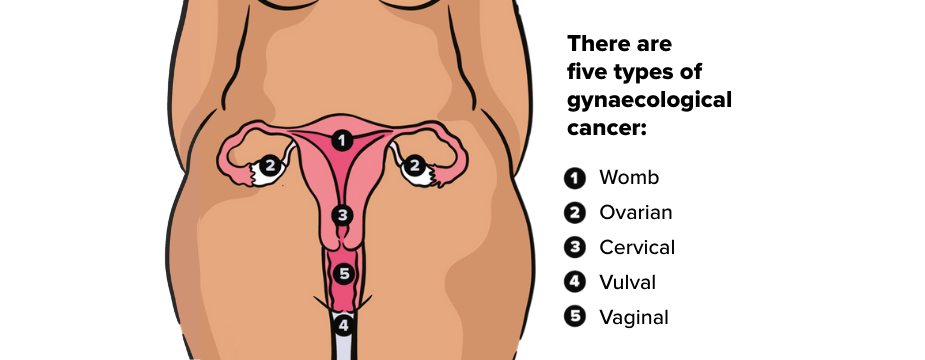
Womb cancer
There are several factors that contribute to womb cancer risk, and some things you can do to reduce your risk. These will not prevent you from getting cancer, but they will help to make it less likely:
- Being overweight means you are likely to have too much oestrogen, increasing the risk of womb cancer. This is because fat cells make and store oestrogen, even after the menopause. This enters the blood stream and over-stimulates the womb-lining, encouraging it to become pre-cancerous or even cancerous. Maintaining a healthy weight, eating a balanced diet, reducing your alcohol intake and being physically active will help reduce your risk.
- Around 3 in every 100 womb cancers are linked to Lynch syndrome. Lynch syndrome is an inherited gene alteration which can be passed down by either parent. It increases the risk of bowel, womb and ovarian cancer. If you have a family history of these cancers you may be eligible for genetic testing. Finding out you have Lynch syndrome gives you opportunities to reduce your cancer risk or to be closely monitored to spot any cancer early when it is most treatable. You can find out more here.
- If you haven’t had a hysterectomy and go on hormone replacement therapy (HRT), it is important to take ‘combined’ HRT which contains 2 hormones, oestrogen and progestogen. Oestrogen helps manage the symptoms of menopause and progesterone prevents the womb lining from becoming too thick. A sequential combined HRT causes the womb lining to thicken and then shed as a withdrawal bleed. This type of HRT is associated with a slightly increased risk of womb cancer compared with not taking any HRT. Continuous combined HRT prevents over-stimulation of the lining of the womb thickening, reducing the risk of womb cancer.
- Taking the combined contraceptive pill can reduce your risk of womb cancer. The longer you take the pill, the more your risk is reduced. Your GP can talk to you about your individual risks and benefits of taking the combined pill.
- Hormonal intrauterine systems (a form of contraception known as the coil or IUD) can decrease the risk of womb cancer by keeping the womb lining thin.
- Having surgery to remove your womb, ovaries and fallopian tubes reduces womb and ovarian cancer risk and is offered as an option to those with Lynch Syndrome
Ovarian
There are several factors that contribute to your risk of ovarian cancer and some things you can do to reduce your risk. These will not prevent you from getting cancer, but they will help to make it less likely:
- Around 15-17 in every 100 of the most common type of ovarian cancers are linked to a BRCA gene alteration. BRCA gene alterations are an inherited gene alteration which increases the risk of breast, ovarian, prostate and pancreatic cancer. If you have a family history of these cancers you may be eligible for genetic testing. Finding out you have a BRCA gene alteration gives you opportunities to reduce your cancer risk or to be closely monitored to spot any cancer early when it is most treatable. You can find out more here.
- Taking the combined contraceptive pill can reduce your risk of ovarian cancer by 30-50%. The longer you take the pill, the more your risk is reduced. Your GP can talk to you about your individual risks and benefits of taking the combined pill.
- Pregnancy and breastfeeding reduce the risk of ovarian cancer.
- Having surgery to remove your ovaries and fallopian tubes reduces ovarian cancer risk and is offered as an option to those with inherited BRCA1 and BRCA2 gene alterations who are at a higher risk of developing ovarian cancer.
Cervical cancer
Nearly all cervical cancers are caused by human papillomavirus (HPV) and there are some things you can do to reduce your risk of high-risk HPV and cervical cancer. These will not completely prevent you from getting cancer, but they will help to make it less likely:
- Get the HPV vaccination if you’re eligible. The HPV vaccination offers protection against the HPV strains most likely to cause cervical cancer.
- Use barrier protection methods like condoms when having sex. They will reduce your risk of getting high-risk HPV but won’t protect you against it completely as HPV can be caught by touching genital skin, including the skin of the vulva and scrotum (the skin around men’s testicles).
- Attending cervical screening when invited to detects high-risk HPV and cervical cell changes which can lead to cancer. These changes can be treated or monitored to prevent cervical cancer from developing.
- Stopping smoking can reduce your risk of cervical cancer. Smoking weakens your immune system and makes it more likely that HPV stays in the cervix and causes cell changes which can lead to cancer if they persist.
Vulval cancer
There are several factors that contribute to your risk of vulval cancer and some things you can do to reduce your risk. These will not completely prevent you from getting cancer, but they will help to make it less likely:
- Stopping smoking can reduce your risk of vulval cancer. Smoking weakens your immune system and makes it less likely to clear HPV.
- Getting the HPV vaccination if you’re eligible. The HPV vaccination offers protection against the HPV strains most likely to cause vulval cancer.
- Using barrier protection methods like condoms when having sex. Condoms can offer some protection against HPV but not full protection as they don’t cover all areas of the genital skin.
- Ensuring any vulval skin conditions are monitored and treated. Some skin conditions on the vulva which cause inflammation, like lichen sclerosus and lichen planus, can increase your risk of vulval cancer. Picking it up early and treating it, as well as regularly self-checking your vulva for skin changes which might become cancer can help you prevent vulval cancer.
- Self-checking regularly. Check your vulva regularly for any changes and symptoms (e.g. persistent itching or soreness) of vulval cancer. That way you can get to know what is normal for you, spot any changes and symptoms, and get them checked by a doctor quickly. This can help pick up pre-cancerous changes (e.g ‘VIN’) which can be treated to prevent cancer from developing, or pick up cancer early, when it is most treatable.
Vaginal cancer
There are several factors that contribute to your risk of vaginal cancer and some things you can do to reduce your risk. These will not completely prevent you from getting cancer, but they will help to make it less likely:
- Stopping smoking can reduce your risk of vaginal cancer. Smoking weakens your immune system and makes it less likely to clear HPV.
- Get the HPV vaccination if you’re eligible. The HPV vaccination offers protection against the HPV strains most likely to cause vaginal cancers.
- Using barrier methods of protection like condoms when having sex. Condoms can offer some protection against HPV but not full protection as HPV can be caught by touching genital skin, including the skin of the vulva and scrotum (the skin around men’s testicles).
More information and advice
We have lots more information on inherited risk, HPV, cervical screening and what happens if you have a HPV positive result. You can also speak to our Ask Eve nurses for free to chat about any worries or questions.





Our health information meets PIF TICK quality mark.
The PIF TICK is a seal of approval from the Patient Information Forum. It helps you know if health information is trusted, evidence-based and accessible.
To be PIF TICK approved, health information creators must prove they meet 10 key criteria and undergo a robust, independent annual assessment.
Information launched: September 2025. Review due: September 2028.