
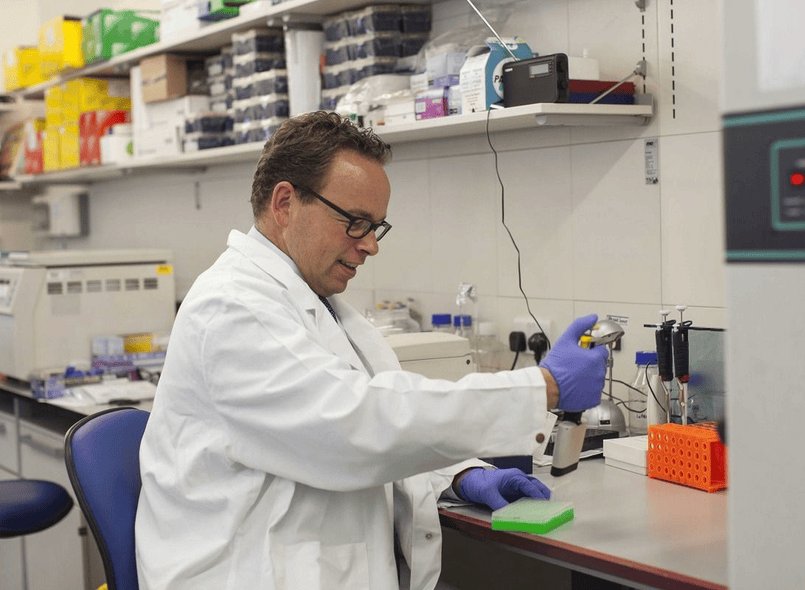
Prof Adam Rosenthal and his team at UCL are working on a way to predict the onset of womb cancer in women with lynch syndrome.
Lynch syndrome is an inherited gene alteration (sometime called mutation) which increases the risk of certain cancers developing, including bowel, womb and ovarian cancer.
The main way that people with lynch syndrome can reduce their risk of the gynaecological cancers is with surgery to remove the womb, cervix and ovaries. This has a huge impact on women, both physically and psychologically, and can plummet them into an early menopause (if they haven’t already been through it).
Because of the impact of the surgery, some women choose not to have it or delay it until after their natural menopause. For these women a form of surveillance to monitor their cancer risk may offer some reassurance. Currently, one option is for women to have an internal ultrasound scan (transvaginal ultrasound) which looks at the thickness of the womb lining, although there isn’t much evidence for how well it works in women with lynch syndrome.
Previous research has shown that cancer in the lining of womb in people with Lynch Syndrome is usually associated with the loss of certain proteins that are important in DNA repair, they are called mismatch repair proteins.
This project hopes to find out whether it is possible to predict the onset of womb-lining pre-cancer and cancer using immunohistochemistry. This is where a sample taken from the womb lining is stained and looked at under a microscope. Immunohistochemistry allows you to see microscopic changes and the loss of these DNA repair proteins in otherwise normal looking womb-lining samples.
If the research shows that loss of DNA repair proteins in normal womb-lining can be seen before pre-cancer or cancer develops, then Adam and his team may be able to use this information to better advise women on the most appropriate time to consider risk-reducing surgery and hopefully give some peace of mind to the women who wish to wait until after they have been through the menopause.
Discover more
Take a look at some of our other research in womb cancer and lynch syndrome.

Fellowship: womb cancer detection
In partnership with North West Cancer Research, we awarded a three-year Fellowship to Dr Kelechi Njoku, from the University of Manchester, to develop a simpler and kinder test for detecting womb cancer. We will be funding Dr Njoku’s work with up to £120,000 each year for the next three years.
Womb cancer surveillance
Professor Martin Widschwendter and his team are planning a large UK-wide clinical trial to improve womb cancer surveillance for women with lynch syndrome.