Please note, information in this blog was accurate at the time of publication. Our blog pages are not updated and some information may have changed since publication.
If you’ve gone to the GP with symptoms of one of the five gynae cancers, you may be referred for future tests and procedures. We run through some of the key procedures, what to expect during your appointment, and some hints and tips for making yourself more comfortable.
This page has information on:
Vulval biopsy
A biopsy is where a small sample of tissue is taken so it can be looked at under a microscope. This is to see what is causing your symptoms. There are two main types of biopsy you might have:
- Punch biopsy
- Wide local excision.
Punch biopsy
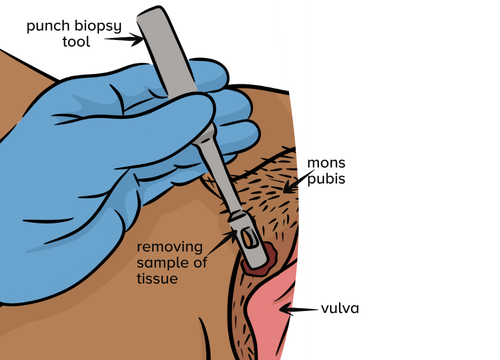
A punch biopsy is an instrument that removes a small circle of tissue, usually around 2-4mm in diameter. A punch biopsy allows the healthcare professional to take a biopsy of skin quickly. Several punch biopsies may be taken.
Before a punch biopsy, you will be given a small injection of local anaesthetic, to make the area numb. Whilst the biopsy is being taken you may feel a pushing sensation, but you should not feel any pain. Sometimes the area is sealed with silver nitrate or a stitch is required.
Hints and tips:
- It is important to rest for 24 hours after the biopsy to reduce the risk of bleeding.
- After your biopsy over the counter pain relief like paracetamol may help ease your discomfort.
- To avoid bleeding, don’t have a bath or shower until 24 hours after your biopsy. Then, it is better to shower for 10 days to allow the biopsy site to heal.
- When you have a wee, the area may sting so you could pour some tepid water over the area, when you wee, to make it less uncomfortable.
- Wear loose clothing
- Avoid sexual intercourse for two weeks to allow the area to heal
- If you develop a high temperature, worsening discomfort or pain, the area is red or warm to touch or you develop a yellow, green or smelly discharge then contact either your GP, 111 or the clinic where you had the biopsy taken.
Wide local excision
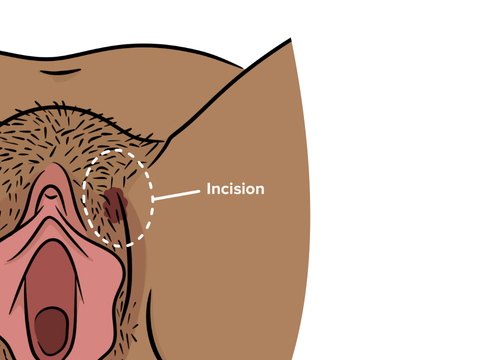
The other type of biopsy you may have taken is a wide local excision. This is when a specially trained doctor will remove the abnormal cells with a small border of healthy tissue from around them, this border is called the margin. The wound will be closed with dissolvable stitches. This is usually done when you are asleep, under a general anaesthetic.
You will be given some painkillers whilst you are asleep to help with any pain when you wake up. Your doctors will be able to give you some other painkillers to help reduce any discomfort.
Hints and tips:
- Try to stop smoking as it slows down healing
- You will feel weak and tired for a few days after your surgery so it is important to rest
- Take any painkillers which have been prescribed regularly to keep any pain under control
- When you have a wee, the area may sting so you could pour some tepid water over the area, when you wee, to make it less uncomfortable.
- Eat a balanced diet to reduce the risk of constipation
- When you feel well enough, gradually increase your level of exercise daily but avoid swimming until any bleeding has stopped and your wound is fully healed.
- Avoid sex for six weeks or until your doctor has confirms your wound has healed.
If you develop a high temperature, worsening discomfort or pain, the area is red or warm to touch or you develop a yellow, green or smelly discharge then contact either your GP, 111 or the ward where you had the biopsy taken.
Internal procedures
Transvaginal ultrasound
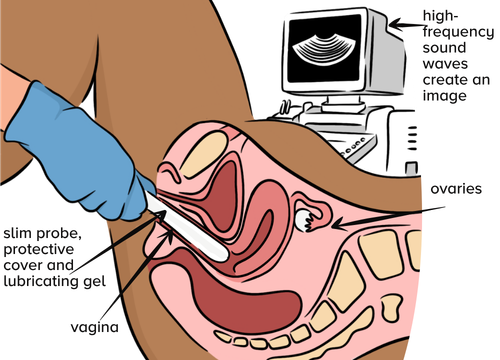
This is a type of ultrasound scan inside the body, it can be used to help your healthcare professional look at your womb, ovaries and other areas of the pelvis. A small scanner is put into the vagina to see the inside of the womb. This may feel a little uncomfortable, but it shouldn’t be painful, unless you have an underlying reason why it might be.
The ultrasound will check for any changes to the thickness of the lining of your womb that could be caused by cancer and or any other problems (such as ovarian cysts, fibroids, polyps and other gynae health problems).
It may be more difficult if you haven’t had penetrative sex, if you have a gynae health problem, if you are post-menopausal or you have experienced trauma. If you’re in pain or worried, do tell the doctor.
Hints and tips:
- If your experience is painful, you can ask the healthcare professional to stop and speak to them about how they can support you.
- Wear comfortable, loose fitting clothing
- If you prefer, you can ask the sonographer if you can insert the probe yourself.
- Taking slow, deep breaths helps your muscles relax, helping to reduce any discomfort.
Hysteroscopy
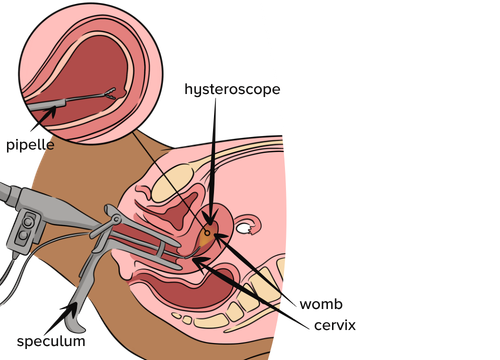
A hysteroscopy is a type of procedure to allow your healthcare professional to look inside your womb. It is done using an instrument called a hysteroscope, a narrow telescope with a light and small camera at the end. It is placed into the vagina, passed through the cervix and into the womb. The doctor or nurse can then the inside of your womb on the screen.
Often a biopsy is done as part of this procedure, this is called an endometrial biopsy and it is taken from the lining of your womb. This will be done in an outpatient department with local anaesthetic or under general anaesthetic. A hysteroscopy can also be used to remove polys and small fibroids.
You can chat with your health care professional about the best way of having your hysteroscopy. This may be with a local anaesthetic, gas and air, sedation or general anaesthetic if you prefer.
Many people will experience some pain during and after their hysteroscopy. If you are having a local anaesthetic, it can help to take some paracetamol and ibuprofen an hour before your appointment. If you are in too much pain, you can ask your health care professional to stop at any time.
Hints and tips:
- Wear loose, comfortable clothes as you will be asked to undress from the waist down and change into a hospital gown.
- Take a period pad with you as you may have some bleeding or discharge after the procedure.
- Avoid strenuous activities for 24 hours.
- Avoid using tampons and having penetrative sex until all your bleeding has stopped.
- You may get some cramping or lower pelvic pain for a few days after your hysteroscopy. Taking painkillers like paracetamol and ibuprofen can help.
Pipelle biopsy
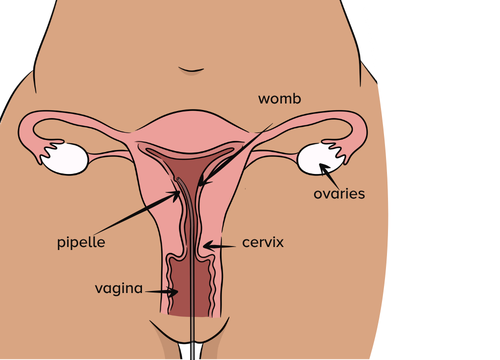
A type of biopsy that allows your healthcare professional to get a small sample of the lining of your womb, so that it can be looked at under a microscope. A pipelle is a thin and flexible tube, like a straw.
A speculum will first be inserted into the vagina to open the vaginal walls and allow your healthcare professional to view your cervix.
Then the pipelle will be inserted through your cervix into your womb. There will be a slight suction through the pipelle, which allows it to take a sample. Several samples may be taken from your womb during the procedure.
You may experience mild period type pain during the procedure. Most women feel a little discomfort for only a short time whilst the biopsy is being taken.
Hints and tips:
- You can take over the counter painkillers like paracetamol or ibuprofen before or after your procedure.
- You can continue with normal activities but do not have sex until any bleeding has stopped completely.
Cervical tests
Cervical screening
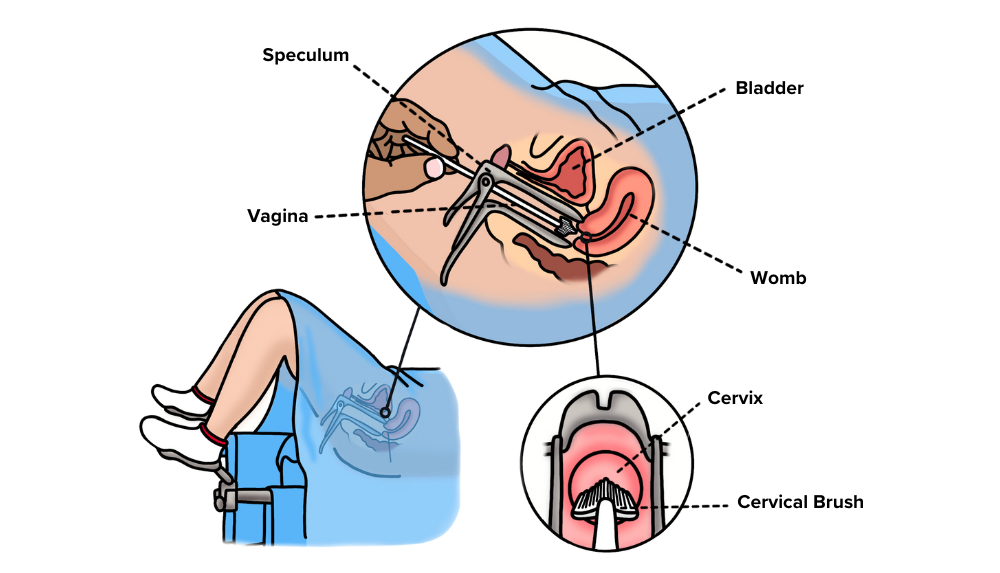
A test (sometimes called a ‘smear test’) that helps prevent cervical cancer. A small sample of cells is taken from the cervix using a speculum (to open up the vaginal walls so the cervix can be seen) and a cervical brush (to collect a sample of cells). The sample is then checked for high-risk types of HPV and if present, changes to the cervical cells, which can be treated or monitored to prevent cancer from developing.
Hints and tips:
Before your appointment
- Ask for a call or appointment to talk through the test. You can see the equipment and ask questions to help prepare for your screening.
- Ask to book a double appointment. Having more time before and after your screening can help you take in information. It will also give you time to process what happens.
- Ask for a healthcare of a particular gender. You may feel more comfortable with a female or male healthcare doing your screening.
- Ask to take someone you trust with you for support. It could be a friend, family member, partner or someone else. They can be in the waiting room or examination room with you.
- Wear a long skirt or dress. If you feel comfortable wearing a skirt or dress, it can help you feel more covered. You can keep it on during the test and only take off your underwear.
During your appointment
- Talk to your healthcare professional about any worries. This can help them support you.
- Ask for a smaller or larger speculum. Speculums come in different sizes. If you find the standard size too uncomfortable, you can ask for another.
- Put the speculum in yourself. You may feel more relaxed and comfortable putting the speculum into your vagina yourself.
- Lie in a different position. Lying on your back may feel uncomfortable for lots of reasons. You can ask to lie on your left-hand side with your knees bent. This is called the left-lateral position.
- Ask to be referred to colposcopy. Sometimes cervical screening tests may be too painful or difficult. A colposcopy clinic has more things to help with cervical screenings that are difficult or painful.
Tips if you need extra support
With vaginal atrophy
Vaginal atrophy causes the walls of the vagina to become thinner, dry and inflamed. This is from a lack of oestrogen. It can affect people at any age but is most common during perimenopause or post-menopause.
Vaginal atrophy can be treated with over-the-counter vaginal lubricants, moisturisers (which are different from lubricants), and you can get prescribed oestrogen-based cream for the vagina.
If you are prescribed vaginal oestrogen, you will be advised to use this for two weeks, stopping one week before screening. No lubricants or moisturisers should be used for two days before screening.
With lichen sclerosus
Lichen sclerosus is a chronic inflammatory skin condition. It can affect any part of the body but is most often on the genitals. For some, lichen sclerosus won’t cause any issues when going for cervical screening. For others, cervical screening may be more painful. This can be from scar tissue around the vulva and vaginal opening.
Using the smallest speculum suitable for you can help. You can also apply vaginal moisturisers for three weeks before your appointment, stopping two days before screening. You can also try booking a double appointment. This will give you more time to talk through your needs and options.
After menopause
During and after menopause, the vagina can become thinner and less able to stretch. This can make the test more uncomfortable.
You can ask for a prescription of vaginal oestrogen cream or pessary. Use this for two weeks and stop a week before your test. This will help make your screening more comfortable.
When on testosterone
If you are taking testosterone, you will have less natural lubrication, which can make a cervical screening test more uncomfortable.
Try using a vaginal moisturiser before the appointment to make using a speculum easier and more comfortable. This is different from a lubricant. Your GP or nurse can prescribe an oestrogen cream or pessary for you to use for a few weeks before your cervical screening, to reduce your vaginal dryness. It is safe to use as it only works on the vaginal tissues to increase lubrication and is not absorbed into the body, so will not affect gender affirming care.
Colposcopy
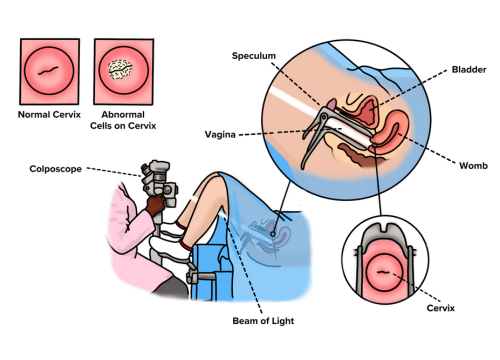
A test to look more closely at your cervix if cervical screening finds any cell changes, which may be caused by HPV, or find out what is causing symptoms (such as abnormal bleeding).
When you’re ready, your colposcopist will put a new, clean sterile speculum into your vagina. They will then use a microscope with a light to have a look at your cervix. This is called a ‘colposcope’. It stays outside your body.
Having a biopsy taken:
- Your colposcopist may take a sample of cells from your cervix. This sample is smaller than a grain of rice and is called a ‘punch biopsy’. Sometimes it’s just called a ‘biopsy’.
- Some people find it uncomfortable, but it shouldn’t be painful. Remember, you’re in control. You can ask your colposcopist to stop at any time.
- If you’re nervous, it’s sometimes possible to have the area numbed (local anaesthetic). If you find it very uncomfortable, you may need to come back. This is so you can have it done under general anaesthetic (where you’re put to sleep). You can also be sedated (where you have an injection to help you relax and reduce pain). Your colposcopist will talk you through your options.
Afterwards you might have:
- Light bleeding (spotting)
- Discharge from your vagina that is brown or has blood in it
- Cramps, like period pains
- We understand this might be worrying. It is common to have some or all of these effects after a colposcopy, even if you didn’t have a biopsy. They normally stop after a few days. If you bleed for more than a week, or if it gets heavier, then contact your GP, hospital or clinic where you had the appointment. You may also have side effects after treatment to remove cell changes.
LLETZ (large loop excision of the transformation zone)
A procedure which involves using a thin wire loop with an electrical current running through it to remove abnormal cervical cells. These changes are not cancer. But, they could turn into cancer if they aren’t monitored or treated.
LLETZ is the most common treatment for cervical cell changes. It can also be used to treat early-stage cervical cancer.

Preparing for treatment
- Like in cervical screening, your colposcopist will gently put a sterile (clean) speculum in your vagina. A speculum is a plastic or metal tube that opens the vagina. It allows your colposcopist to see your cervix. Speculums come in different sizes. If the standard size is uncomfortable or painful, you can ask for a smaller one.
- Your colposcopist will inject a local anaesthetic into your cervix. This means you are awake, but your cervix is numb. You won’t be able to feel anything. The injection might sting for a short time. You may notice your heart beating faster. This should only last a few minutes. You may also have a sticky pad put onto your leg. This is for your safety as LLETZ uses electricity. Before your treatment starts, your colposcopist will touch your cervix to check it is numb.
Having your treatment
- When your cervix is numb, your colposcopist will use the loop to remove the area of your cervix that has cell changes. It is normal to notice a slight burning smell and hear a noise like a soft vacuum cleaner.
- The loop cuts the tissue. Another small tool is then used to seal the cut. This should not be painful, but you may feel some pressure. The appointment takes around 20-30 minutes.
- The cells that have been removed are sent to a laboratory. They will check that the changed cells have been removed. They will also check what type of cell changes or cervical cancer you had.
- Most of the time you just need one treatment. A small number of women and people with a cervix may need a second treatment.
After your treatment
- Once the anaesthetic has worn off, you may have some bleeding.
- Your colposcopist should offer you a period pad. You might prefer to bring your own.
- Do not use tampons or menstrual cups.
- It is normal to have some bleeding and changes to your vaginal discharge after LLETZ. The bleeding and discharge may last up to four weeks. It will stop as the cervix heals. You may also experience some cramp-like pains, which can feel like period pain.
- Some people may have pain for longer. It normally goes away within three months. If you are in a lot of pain or it is affecting your day-to-day life, talk to your GP.
References:
More information
This Gynaecological Cancer Awareness Month we are talking all about pain so that you can get to know your normal and spot when you might need to get checked by a doctor. We also have lots more information on the five gynae cancers. You can also speak to our Ask Eve nurses for free and confidential information and support.