
This page has information on:
You will get your cervical screening results via the NHS App or in the post. Your results will explain if you have human papillomavirus (HPV).
Most people (nearly 9 in 10) will be HPV negative. If your results are HPV negative then no HPV was found on your cervix. This means you have a very low risk of cervical cancer. You will be invited back for cervical screening as normal in 3-5 years, depending on your age and where you live in the UK.
Sometimes the result will be ‘inadequate’. This isn’t anything to worry. It means the laboratory couldn’t get a HPV result or see if there were any cell changes from your sample. If your result was inadequate, you will be invited for another cervical screening test in three months. This is so they can take a new sample.
Just over 1 in 10 women and people with a cervix will test positive for HPV. If HPV is found, your results will explain what will happen next. If they found HPV but no changes to the cells of your cervix, then you will be invited to another cervical screening test in one year.
If your test found HPV and changes to the cells in your cervix (called dyskaryosis), you will be invited for a test to look more closely at your cervix. This test is called a colposcopy. These changes to the cells are not cancer. These cell changes are ‘precancerous’. This means they could develop into cancer over time if they are not treated.
I have cervical cell changes. Does that mean I have cancer?
No, it doesn’t. Cervical screening tests (which used to be called smear tests) help prevent cervical cancer. They do this by looking for high-risk human papillomavirus (HPV). HPV is the common virus that causes nearly all cervical cancers. If HPV is found, then they look for changes to the cells in the cervix. These changes may be called abnormal cells or dyskaryosis. These are usually caused by HPV.
HPV is transmitted through skin-to-skin sexual contact. Most of the time it is cleared by the immune system without causing any problems. If HPV isn’t cleared, it can sometimes cause changes to the cervical cells. These changes are not cancer. But, they could turn into cancer if they aren’t monitored or treated.
I have HPV and cell changes, what happens next?
If you have cervical cell changes you will be invited for a colposcopy appointment. Colposcopy allows your nurse or doctor to see your cervix closely. They can then see if there are any cell changes. Colposcopy is done by a specially trained nurse or doctor called a ‘colposcopist’.
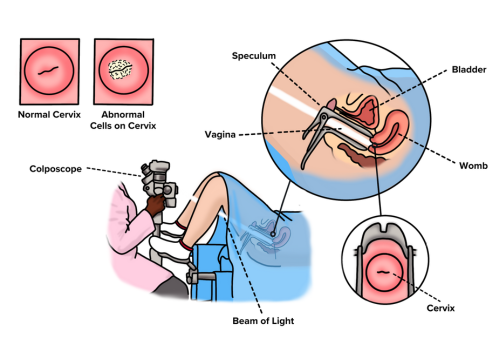
Colposcopy normally happens in a hospital or local clinic. It usually takes 10–20 minutes. It might be a bit longer, depending on what happens during your appointment.
The colposcopist will use a plastic tool called a speculum to gently open the vagina. They will then use a colposcope to see the cervix. A colposcope is a microscope with a light, which stays outside the body. A dye may be put on the cervix to make any cell changes easier to see.
The most common type of cell changes are cervical intraepithelial neoplasia (CIN). The less common types are cervical glandular intraepithelial neoplasia (CGIN) and stratified mucin-producing intraepithelial lesion (SMILE).
Many cell changes go away on their own. Sometimes, they can turn into cervical cancer if they are not monitored or treated. Colposcopy helps find out whether any changed cells need to be treated to reduce the risk of cervical cancer in the future. In your colposcopy appointment, a sample may be taken from your cervix. This is called a biopsy. It will be sent off to a lab for testing. Your doctor will recommend what happens next based on your results.
I have CIN, what does this mean?
CIN or cervical intraepithelial neoplasia the most common type of cervical cell changes. CIN is graded between 1-3. 1 is low grade, 2 and 3 are high-grade cell changes.
- CIN1- there are changes in a third of the cells in the outer layer of the cervix
- CIN 2- there are changes in two thirds of the cells in the outer layer of the cervix
- CIN 3- there are changes in all layers of the cells in the outer cervix.
None of these changes mean you have cancer. It is important they are monitored or treated to stop them turning into cancer in the future.
What is the treatment for CIN and how does it work?
The results of your colposcopy will tell you your type and grade of cell changes.
If you have CIN1, you will probably be monitored. This is because CIN1 often goes back to normal cells on its own. You will have another cervical screening test in one year’s time. This is to check if you still have high-risk HPV and any cell changes.
If you have CIN2 your doctor will explain your options. You will be monitored or offered treatment. CIN2 can still go back to ‘normal’ cells without treatment. But is less likely than CIN1.
If you have CIN3, you will be offered treatment. CIN3 is still not cervical cancer. But it is more likely to turn into cancer if it isn’t treated.
The most common treatment for CIN is a large loop excision of the transformation zone (LLETZ). A local anaesthetic is used to numb your cervix. Then a thin, heated wire loop is used to remove the area of changed cells.
CGIN and SMILE are treated differently to CIN and your doctor will talk to you about this.
I have CGIN/SMILE, what does this mean?
CGIN stands for cervical glandular intrepithelial neoplasia. CGIN is named after the parts of the cervix it affects, the glandular cells inside the cervical canal. CGIN is not cervical cancer. CGIN is a type of change to the cells. It can turn into cancer over time if it isn’t treated. If you have CGIN, you will usually be offered treatment. As glandular cells are inside the cervical canal, they cannot be seen or monitored easily.
How is CGIN graded?
CGIN is usually graded as:
- low grade
- high grade.
If you have any grade of CGIN, you will be offered treatment.
CIN is the most common type of cell changes. CGIN is the second most common. But there are other types of cell changes you can have, like SMILE.
SMILE stands for stratified mucin-producing intraepithelial lesion. It is much rarer than CGIN but treated in a similar way.
CGIN and SMILE are usually treated by LLETZ. Your colposcopist will talk you through the best treatment options for you.
If you have questions about SMILE or CGIN you can speak to your colposcopist, or you can contact our Ask Eve Nurses for free and confidential advice.
Your frequently asked questions
We have answered some of your most common questions about cervical cell changes.
I have cervical cell changes and I’m in a long-term relationship. Does that mean my partner cheated on me?
No, it doesn’t. HPV is very common. 8 in 10 people have it at some point in their lives. It is transmitted by skin-to-skin contact. This is different to other STI’s. It can be anywhere on your skin, like your fingers and mouth. HPV can also be transmitted by sharing sex toys. You can get HPV from just one sexual experience. You do not need to have had penetrative sex to get HPV.
HPV can be dormant for many years, or even decades. It can take a long time to cause any cell changes. It is usually not possible to tell when someone ‘got’ HPV and who from. This is why it is important to go for your cervical screening test, no matter your sexual orientation. Cervical screening tests are important for trans men, non-binary people, and women who sleep with women too.
My friend had abnormal cells and wasn’t treated. Why is this different to me?
Everyone is different, and there are different types and grades of cell changes. There may be other factors your doctor has thought about, like your medical history. Please don’t worry if you have been offered a different treatment to someone else you know.
Who can I talk to if I am worried about cervical cell changes?
Your nurse or doctor will be able to help you. They can answer any questions about cervical cell changes and treatments. You can also call or email Ask Eve to speak to our nurses.
More information and advice
We have lots more information HPV, cervical screening and what happens if you have a HPV positive result. You can also speak to our Ask Eve nurses for free to chat about any worries or questions.




Our health information meets PIF TICK quality mark.
The PIF TICK is a seal of approval from the Patient Information Forum. It helps you know if health information is trusted, evidence-based and accessible.
To be PIF TICK approved, health information creators must prove they meet 10 key criteria and undergo a robust, independent annual assessment.
Information launched: April 2025. Next review due: April 2028.