
Everyone has BRCA1 and BRCA2 genes. They are tumour suppressor genes and they help protect us from cancer. They try stop the cells in our bodies from growing and dividing out of control. If there is a significant change on either gene (called an alteration or mutation) they may not be able to protect us from breast, ovarian, pancreatic and prostate cancers.
What is the cancer risk of a BRCA gene alteration?
Of every 100 people, approximately the following amount will develop a cancer before they are 80:
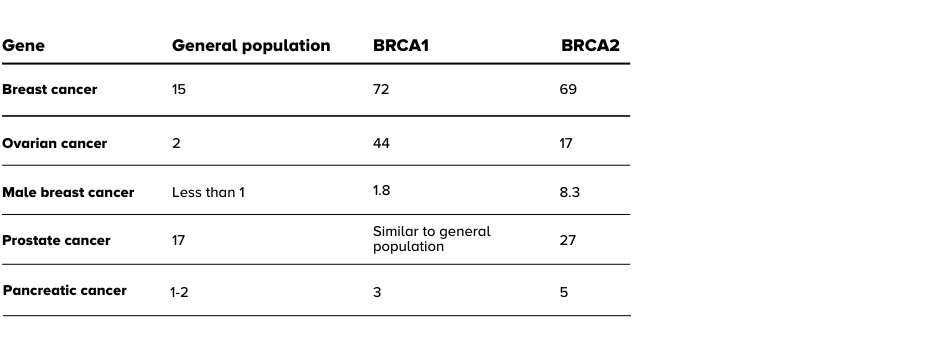
*Source: Kuchenbaecker KB , Hopper JL , Barnes DR , et al . Risks of breast, ovarian, and contralateral breast cancer for BRCA1 and BRCA2 mutation carriers. JAMA 2017;317:2402–16.doi:10.1001/jama.2017.7112 pmid:28632866.
How common are BRCA gene alterations?
Around 1 in every 400 people in the general population will have a BRCA gene alteration. In some populations, they are more common. People of Ashkenazi Jewish descent have around a 1 in 40 chance of having a BRCA gene alteration.
Why might someone get tested for a BRCA gene alteration?
Finding out you have a higher risk of cancer can be a lot to process. It does offer some chances to either prevent certain cancers with risk-reducing surgery or catch them in the earliest stages with symptoms awareness or surveillance. Cancer diagnosed early can be easier to treat. Genetic testing can also open up treatment options for breast and ovarian cancer. It can also help other family members get tested and help you make decisions if you’re starting a family.
Who is eligible for BRCA testing?
Someone will be eligible for BRCA testing if they have a high risk of having a BRCA gene alteration. You have a higher chance of having a BRCA alteration if you have a family history of breast, ovarian or prostate cancer. This includes anyone who has two or more close relatives (siblings, parents or children) with any of these cancers. It also includes people with a close family member who was diagnosed with one of these cancers under the age of 50. Anyone diagnosed with ovarian, breast, prostate or pancreatic cancer may be eligible for BRCA testing.
In England anyone of Jewish ancestry (of any origin) is eligible for BRCA testing. You can find out more about this and how to access testing at nhsjewishbrcaprogramme.org.uk.
New research around BRCA alterations and genetic testing is coming out all the time.
The information on this page was correct at the date of publication (01.02.2024). Your GP, genetics counsellor or oncologist will be able to help with the most up to date advice. You can also contact our Ask Eve nurses.
Our health information meets PIF TICK quality mark.
The PIF TICK is a seal of approval from the Patient Information Forum. It helps you know if health information is trusted, evidence-based and accessible.
To be PIF TICK approved, health information creators must prove they meet 10 key criteria and undergo a robust, independent annual assessment.
Information updated: November 2024. Next review due: November 2027
More information and advice
If you have found out you have a BRCA gene alteration, we have more information and advice. You can also speak to our Ask Eve nurses for free to chat about any worries or questions.