
Today, research supported by The Eve Appeal was published in the Journal of Clinical Oncology, reporting a new test which can reliably detect womb cancer from a cervical screening sample. Eve Appeal Communications Manager Lydia Brain and Research Co-ordinator Sara Sleigh blog about the news.
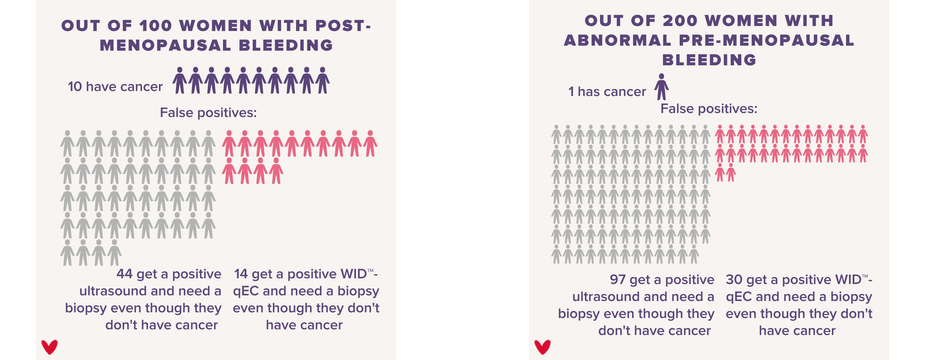
Womb cancer can be difficult to detect. Abnormal bleeding is the red-flag symptom for the disease- but 9 out of 10 post-menopausal women with abnormal bleeding do not have womb cancer and as few as 1 in 200 premenopausal women with abnormal bleeding will have womb cancer.
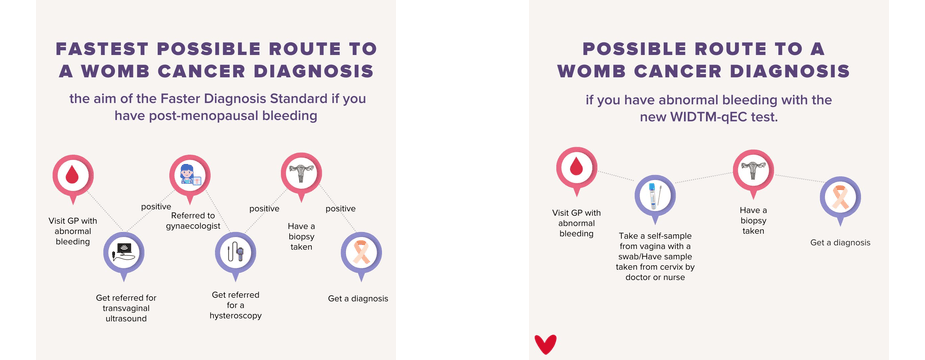
Once someone has been referred for investigations from the GP, they will have a transvaginal ultrasound (a type of ultrasound scan that uses a small scanner probe, placed into the vagina to get a detailed picture of the inside of the womb). These ultrasound scans look at the thickness of the womb lining, with a thicker womb lining indicating a potential cancer.
Transvaginal ultrasounds are good at detecting cancer in post-menopausal women, however, the method isn’t very specific – not everyone with a thick womb lining will have cancer. This means that many women have to undergo additional invasive procedures before a diagnosis can be made, like a biopsy, with or without hysteroscopy (when a narrow telescope with a light and small camera at the end which is placed into your vagina, passed through your cervix and into your womb).
Detecting womb cancer in pre- and peri-menopausal women is more complicated as in pre-menopausal women the thickness of the womb fluctuates throughout the menstrual cycle, and it’s much less common to get womb cancer before the menopause. It can also be more difficult to get that initial referral from the GP as womb cancer isn’t the likely cause of abnormal bleeding in younger women, resulting in delays to diagnosis. Transvaginal ultrasounds are also less effective at detecting womb cancer in Black women, who have a higher rate of non-cancerous womb conditions such as fibroids. This is one of the reasons behind Black women getting later diagnoses and having poorer outcomes when it comes to womb cancer.
The much-needed new test, called the WIDTM-qEC test, could reliably and accurately identify womb cancer, and we hope in the future could be offered to all women and people with gynae organs presenting with abnormal bleeding symptoms. This test would speed the detection of womb cancer, reduce the number of invasive diagnostic procedures, and help improve outcomes for those with womb cancer.
The WIDTM-qEC test is the result of the FORECEE project led by Prof Martin Widschwendter from University of Innsbruck, University College London and the Karolinska Institute in Stockholm. It uses samples collected from the cervix or vagina to identify whether someone has womb cancer or not. The research used 1,288 cervical screening samples from women with and without womb cancer collected by a large team of investigators across the UK and Europe.
The WIDTM-qEC test examines three regions of the DNA that show different levels of methylation, a type of modification “on top” of the DNA, in those with or without cancer. DNA methylation levels are measured by PCR, which is relatively low-cost and used routinely in clinical diagnostic labs, like in the detection of coronavirus.
The WIDTM-qEC identified all eight of the womb cancers within a cohort of 63 women presenting with post-menopausal bleeding, and only a few women without cancer had a positive result (which is 100% sensitivity at 89% specificity).
The test also delivered reliable results when the sample was self-collected with a vaginal swab, which could speed up the detection process further, and reduce some of the barriers to getting to an appointment and having a cervical sample taken. The WIDTM-qEC performed better than both the current “gold standard” techniques – ultrasound – and DNA mutation analysis (a method currently being explored for womb cancer detection).
In samples from a Swedish biobank, the WIDTM-qEC was also shown to detect 91% of womb cancer cases up to 1 year prior to diagnosis at a specificity of 100%, which means no false positives. This is important in screening settings, as it means no-one cancer-free would have to undergo invasive hysteroscopy procedures. The WIDTM-qEC test worked equally well on pre-, peri- and post-menopausal women, and equally well in Non-white and White women, although more research is needed to test this further.
Today’s research has delivered a potentially exciting new test that early results show may reliably detect womb cancer and to speed up diagnosis, so that women and people with gynae organs with womb cancer can begin treatment as soon as possible, and those without can avoid invasive investigations. The next stage of this research has already begun with clinical studies to further validate these results.
This research would not have been possible without your fantastic support or without all of the volunteers who took part. Thank you so much, we look forward to updating you on future developments.
This research was funded by the EU’s Horizon 2020 and European Research Council programmes, The Eve Appeal and the regional government of the Tirol region of Austria (Land Tirol).
More information and advice
You can read the paper in full in the Journal of Clinical Oncology. We have lots more information and advice on womb cancer. You can also contact our Ask Eve nurses for free to chat about any worries or questions.